It’s been a busy spring in the other Washington, with WSU faculty, staff, and students visiting the nation’s capital to share impactful research and expertise with federal legislators.
Resilient Livestock and Food Security
WSU’s Jon Oatley helped lead a congressionally mandated report on genetically modified food animals. Oatley was among a select few scientists who unveiled a national report last month that will shape the future of research and regulation around the genetic modification of cattle, pigs, and other food animals.
Dr. Oatley, a prominent ambassador for the field, was one of four members of a committee of the National Academies of Science, Engineering and Medicine who introduced the congressionally mandated report in a public webinar after sending the report to Congress. Learn more about the report HERE.
Bringing Digital Resources to Rural and Tribal Communities
Associate Professor Dan Teuteberg met with federal lawmakers in March to discuss digital inclusion initiatives and the Digital Equity Act. WSU Extension plays a leading role in these efforts throughout Washington state.
Dr. Teuteberg, a 4-H Youth Development Regional Specialist and Director of WSU Extension Mason County and Grays Harbor County, met with Senator Patty Murray and Representative Dan Newhouse to talk about the direct impact federal funding has had on bringing digital resources to rural Washington.
Addiction Treatment and Mental Health
Elizabeth Weybright, Associate Professor & Adolescent Extension Specialist, was in DC to offer her expertise at an event hosted by The Science Coalition on the science of addiction and mental health. The event showcased how federally funded research at the nation’s top institutions—including WSU—is driving groundbreaking advancements in addiction treatment and mental health care.
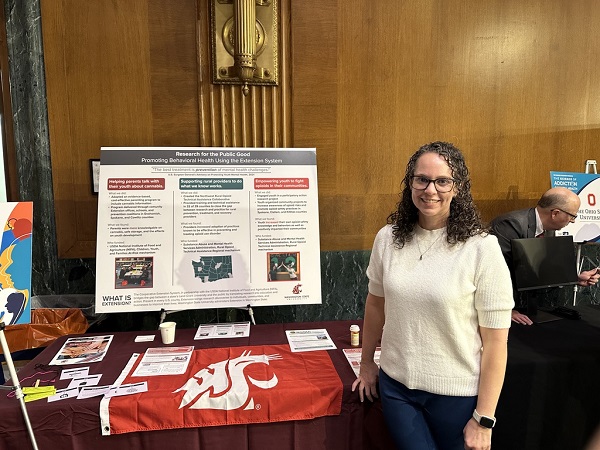
WSU Extension Forestry & Broadband
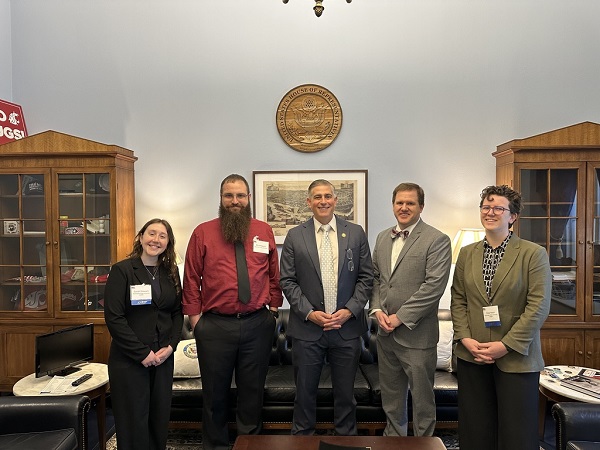
WSU Extension leaders were in DC attending the Public Issues Leadership Development Conference, conducted by and for Extension professionals. While in DC, Kevin Zobrist, Quinn Merrick, Sarah Stewart, and Nick Pappin also met with Representative Baumgartner. Kevin led discussion on the efforts of WSU Extension Forestry, a reliable source of unbiased, research-based information for small forest landowners. WSU Extension Forestry provides critical education and technical support to landowners to help them navigate complex regulations, climate impacts, forest health issues, and generational transitions. Nick led discussion on how WSU Extension partners with the Washington State Broadband Office to support.
In addition to these visits, ASWSU students Collin Bannister and Bhargav Iyer traveled to DC to advocate on behalf of WSU students and met with the state’s congressional delegation as part of United States Student Association.
WSU TRIO professionals and students from across the state attended the annual Council for Opportunity in Education’s Policy Seminar in March. As part of the seminar, they were able to meet with members of Congress and discuss the important role TRIO programs play in the state and for WSU students.
College of Nursing Dean Mary Koithan met with the congressional offices as part of a Colleges of Nursing Hill Day to discuss key issues shaping the future of academic nursing. Drawing on WSU’s leadership in the field, she shared insights on the current state of the nursing workforce in Washington and what is needed to expand and sustain the profession across the state. Dean Koithan also highlighted research led by WSU nursing scientists advancing health outcomes, driving new cures, and exploring the use of AI to enhance nursing practice and patient care.
College of Veterinary Medicine Dean Dori Borjesson made the rounds on Capitol Hill in April to explain the vital role CVM plays in global health. Researchers in the WSU College of Veterinary Medicine are funded through grants at the FDA, CDC, and NIH to study disease outbreaks like avian influenza and how that can have an impact on livestock and public health–both in the state and globally.