Washington State University welcomed congressional and legislative staff to Pullman this week for the 2026 WSU Staff Tour—a long‑running tradition that gives policy leaders a firsthand look at how higher education and research shape communities across Washington.
President Cantwell: A Future-Ready Land Grant
WSU President Betsy Cantwell welcomed the group and outlined the university’s role as Washington’s land grant institution, serving all 39 counties through education, research, Extension, and community partnerships.
She highlighted the measurable returns generated by public investment in higher education, including WSU’s nearly $4 billion annual economic impact and its role in preparing Washington’s workforce.
President Cantwell noted that even as the federal research landscape shifts, WSU continues to earn bipartisan support because of its commitment to applied research, citing the Cosmic Crisp apple as an example of innovation. The apple was designed to withstand climate change, smoke, and water scarcity.
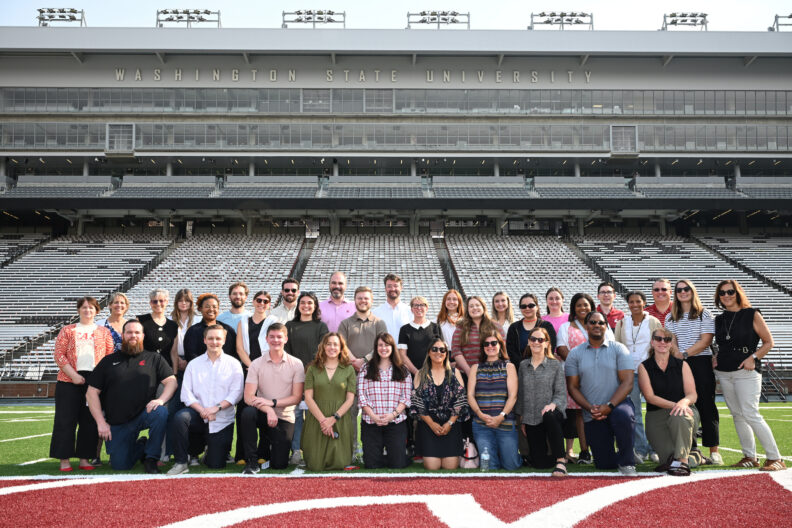
The President also underscored the strategic importance of WSU Athletics—a major front door to the university that drives visibility, community pride, and economic activity. Speaking from the Champions Center, she emphasized WSU’s commitment to supporting student‑athletes academically, personally, and professionally.
Student Voices at the Champions Center
The group then heard from several student athletes in a conversation moderated by WSU Women’s Soccer Coach Chris Citowicki.
“My mission is to ignite young people,” Coach Citowicki said. “Our job is to help set them up to succeed 20 years from now—and teach them the life skills, job skills, and communication skills necessary to be successful.”
Student athletes shared how facilities like the Champions Center and other resources at WSU support their growth on and off the field. Several members of the Student Athlete Advisory Committee spoke highly of their experience getting a seat at the table as important policy and resource decisions are made.
Understanding the WSU Budget
The second day began with a session led by Executive Vice President for Finance and Administration and Chief Financial Officer Leslie Brunelli, who walked staff through how WSU stewards its resources to serve all 39 counties.
Brunelli outlined the university’s budget structure, major cost drivers, and the strategic investments that sustain WSU’s research enterprise, student support, and statewide Extension network. Participants gained a clearer understanding of how a modern land grant university balances affordability, access, and long‑term financial resilience.
WSU ROAR: Expanding Access and Opportunity
At Cleveland Hall, staff met with WSU ROAR Director Kristi Tippett and students in the ROAR program—a two‑year inclusive postsecondary education experience for students with intellectual and developmental disabilities.
Participants heard directly from ROAR students about how the program builds independence, workforce readiness, and community belonging.
Centering Tribal Communities
At the Elson S. Floyd Cultural Center, Terri Parr, executive director and presidential liaison for Tribal Relations led a powerful conversation on tribal sovereignty, educational partnerships, and community‑driven research.
Jerry Crowshoe, Native American Health Sciences Program Director, highlighted WSU’s innovative Little Birds program, which aims to inspire the next generation of Native health leaders by exposing young children to careers in medicine. The program grew out of conversations with WSU’s Tribal Advisory Board.
Caj Matheson, Councilman with the Coeur d’Alene Tribe, emphasized the importance of trust, long‑term relationship building based on mutual respect, and culturally grounded approaches to health, education, and economic development. Staff gained insight into how WSU collaborates with tribal nations across the region to advance shared priorities.
Agriculture, Innovation, and the Land Grant Mission
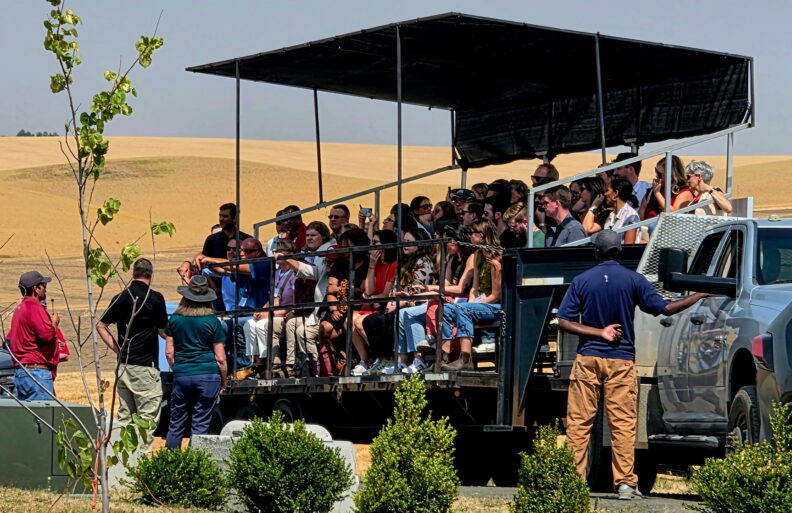
The afternoon shifted to Spillman Farm, where College of Agriculture, Human, and Natural Resource Sciences (CAHNRS) Dean Raj Khosla welcomed the group to the WSU Horticulture Center. Over several sessions, faculty showcased how WSU research strengthens Washington’s agriculture sector—from wheat breeding to climate‑smart technologies.
- Mike Pumphrey demonstrated how WSU’s wheat breeding program develops resilient varieties that support growers statewide.
- Lav Khot introduced AgWeatherNet, the statewide weather‑monitoring system that provides real‑time data to farmers.
- Ananth Kalyanaraman highlighted the AgAID Institute’s work applying AI to agriculture, improving forecasting, automation, and decision‑making.
These sessions illustrated how WSU research directly supports Washington’s food security, economic competitiveness, and climate resilience.
USDA ARS and Food Science
At the USDA Agriculture Research Sciences (ARS) Building, staff heard about collaborative research that strengthens Washington’s tree fruit and potato industries. WSU and USDA scientists work side-by-side to address critical challenges facing national and global agriculture. The construction and opening of this federal facility highlights the importance of the partnership and collaboration between WSU and the agricultural stakeholders we serve.
The long history of partnership between the USDA ARS (which began in 1931 and is one of the nation’s “most robust federal-state partnerships”) and WSU has supported some of Washington’s most important agricultural sectors and demonstrated why continued investment in agricultural research delivers returns for producers, communities, and consumers.
The day concluded with a visit to WSU’s Food Science and Human Nutrition Building, where Professor Girish Ganjyal showcased WSU’s food processing research and Extension programs—critical supports for Washington’s food manufacturing sector.
The group ended the day enjoying a meal featuring fresh local ingredients from the Palouse made by Executive Chef and Culinary Director Mat Morgan and hospitality students in WSU’s Marriott Foundation Hospitality Teaching Center.
Protecting Innovation: Research Infrastructure & Security
The final day opened in the brand new Schweitzer Engineering Hall, opening this Fall, with Vice President for Research Kim Christen and WSU Chief of Police Dawn Daniels. They outlined how WSU protects research integrity, secures sensitive data, and maintains compliance in an increasingly complex research environment. Staff gained a deeper understanding of the infrastructure required to support a $400M research enterprise.
Materials Research and AI Applications
At the Institute for Materials Research, Director David Field introduced participants to cutting‑edge materials science research with applications across aerospace, energy, and manufacturing.
Professor Jana Doppa demonstrated how WSU researchers are applying AI to solve real‑world problems—from optimization to predictive modeling- with Professor Nghia Hoang providing a case study from his research in rural communities where AI is being used to accelerate the analysis of brain scans.
In the Engineering, Teaching, and Research Lab Building on campus, Professor Jit Mojumder and his graduate students showed how AI is transforming manufacturing processes, improving efficiency, safety, and product quality.
Workforce Development: Preparing Washington’s Future
Two panels moderated by Provost Chris Riley-Tillman highlighted WSU’s role in preparing Washington’s workforce across high‑demand sectors.
Panelists included leaders from WSU’s new MS in AI program, manufacturing and sustainable fuels, social work, Schweitzer Engineering Labs, and Pullman Regional Hospital. They emphasized the importance of industry‑aligned curriculum, hands‑on learning, and partnerships that connect students to high‑quality jobs.
Student Voices: TRIO/SSS and Native Coug Scholars
During lunch, staff heard from students in TRIO/SSS and Native Coug Scholars—programs that support first‑generation students, low‑income students, and Native students across WSU’s system. Students shared how mentorship, community, and targeted support have shaped their academic journeys.
Nuclear Science Center
The group then toured the Nuclear Science Center with Director Corey Hines and Associate Director Zach Heiden, learning how WSU’s research reactor supports education, national security, and scientific discovery. This year marks 65 years since WSU’s reactor first went active. The NSC tour wrapped with a preview of the new 5,000 square foot facility under construction that will house three hot cells for nuclear research and a chemistry wet lab, expected to open later this year. Construction on the $7.6 million building was funded by a congressionally directed spending request supported by Sen. Patty Murray.
Ferdinand’s Creamery
The tour concluded at Ferdinand’s Creamery—one of WSU’s most beloved landmarks—where participants got a behind‑the‑scenes look at production and a chance to sample Cougar Gold and other WSU‑made dairy products.