WSU leadership joined the state’s agricultural commodity partners in Washington, D.C. for meetings with Members of Congress and key congressional staff. The delegation highlighted the vital collaboration between WSU, the Washington State Department of Agriculture (WSDA), and commodity organizations that fuel innovation, research, and competitiveness across the state’s agricultural economy.
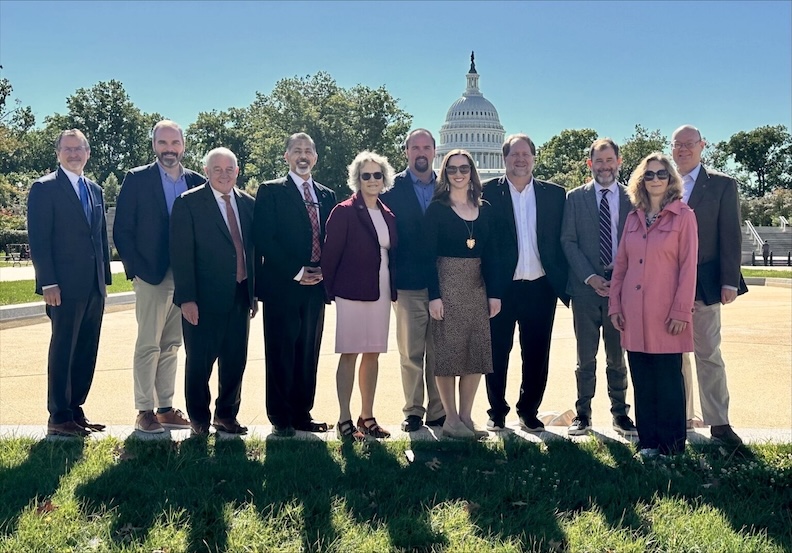
The WSU delegation included President Elizabeth Cantwell, Provost Chris Riley-Tillman, Dean of the College of Agricultural, Human, and Natural Resource Sciences Raj Khosla, Vice President for External Affairs and Government Relations Glynda Becker-Fenter, and Director of Federal Relations Jacob Dowd. They were joined by WSDA Director Derek Sandison and leaders representing Washington’s diverse agricultural industries, including the Washington Potato Commission, Washington Grain Commission, Washington Dairy Federation, Washington Wine Commission, Washington Tree Fruit Association, and Washington Association of Wheat Growers.
Throughout the week, the delegation met with nearly the entirety of Washington’s congressional delegation, including staff from the offices of Senators Patty Murray and Maria Cantwell, Representative Dan Newhouse, Representative Kim Schrier, and staff representing Representative Michael Baumgartner. The group also met with professional staff from both the House and Senate Agriculture Committees to discuss priorities critical to Washington’s agricultural economy and research enterprise.
Advocating for Research, Trade, and the Next Farm Bill
Discussions centered on sustaining Washington’s leadership in agriculture through research investments, market access, and science-based innovation. The delegation emphasized the importance of federal capacity funds—such as Hatch, Smith-Lever, and McIntire-Stennis programs—which serve as the foundation for WSU’s statewide research and extension network.
These investments allow faculty, students, and county-based specialists to deliver timely, practical solutions to growers facing challenges from pests, drought, and shifting global markets.
Participants also underscored the value of trade programs, including the Market Access Program (MAP) and the Specialty Crop Research Initiative (SCRI), which help Washington producers remain competitive in global markets. Conversations included potential implications of a Farm Bill 2.0 and the need to maintain strong support for programs that underpin Washington’s export-driven, science-dependent agricultural economy.
Technology and the Future of Agriculture
With new tools transforming production agriculture—from AI and drone systems to precision irrigation and gene editing—the delegation discussed how federal policy must evolve to keep pace with innovation. WSU and its partners urged lawmakers to modernize regulatory frameworks governing agricultural biotechnology and drone use, expand digital infrastructure in rural communities, and support research partnerships that integrate artificial intelligence and data science into agriculture.
“Technology is changing how we grow, harvest, and manage resources,” said Dean Raj Khosla. “Federal investments in research and innovation ensure that Washington’s producers have access to the best tools and knowledge available keeping our agriculture sector competitive, sustainable, and ready for the challenges of tomorrow.”
Continuing the Land-Grant Mission
The visit reaffirmed WSU’s role as the state’s land-grant university—bridging academic research with industry needs and serving communities statewide. Together with WSDA and Washington’s commodity organizations, WSU continues to advocate for investments that sustain a resilient, future-focused agricultural sector.